The Pitfalls of “Sharpe World” Thinking
“Sharpe World” thinking is inadequate for today’s complex and unpredictable markets. It fails to account for the chaotic, non-linear realities of financial markets.

Introduction: The Pitfalls of “Sharpe World”
In modern finance, the pursuit of risk-adjusted returns has led to a widespread reliance on measures like the Sharpe ratio, standard deviation, and Value at Risk (VaR). This framework—what David Dredge aptly calls ‘Sharpe World’—has shaped how investors think about risk, yet it is fundamentally flawed.
The 2008 financial crisis wiped out nearly $19 trillion in global wealth, yet just months before, risk models showed no indication of an impending collapse. Why? Because they relied on the past to predict the future—ignoring the fundamental reality that the most significant market moves are always unexpected.
The regularity of unforeseen market crises that blindside investors is not an anomaly but a direct consequence of this flawed framework. Risk models work until they catastrophically fail, reinforcing a dangerous illusion of control over markets that are inherently unpredictable.
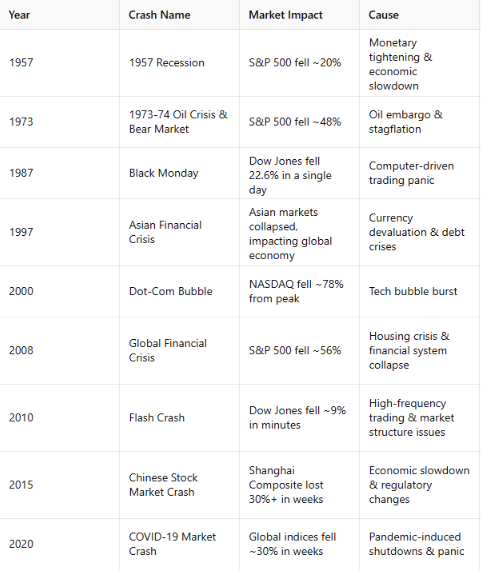
The fundamental issue is that risk models tend to measure what has already happened, rather than preparing for what has never occurred before. When the next major crisis arrives, it will not be a variation of past events—it will be something completely different. Refer to the table below that lists some of the most significant financial crashes that blindsided the investment community despite their reliance on traditional risk models.
Risk is Not Volatility
One of the greatest misconceptions in finance is the belief that risk equates to volatility. This assumption underpins much of Modern Portfolio Theory (MPT), the Efficient Market Hypothesis (EMH), and standard risk management practices. But history has shown us that the most damaging risk events are not the ones we expect, but the ones we don’t see coming.
If risk could be forecasted using historical distributions, then risk management would be easy. But every major financial crisis—from Black Monday to the Global Financial Crisis—occurred because the models failed to anticipate the unexpected. As Dredge, describing Nassim Taleb’s insights, puts it: “Understanding is a poor substitute for convexity.” Risk isn’t about predicting the next crisis; it’s about building a portfolio that can survive and exploit uncertainty.
The Flawed Assumptions of 'Sharpe World'
Traditional financial models rest on several assumptions that, while convenient for theoretical frameworks, have repeatedly failed in real-world market conditions. These flawed assumptions create a false sense of security, leading to systemic fragility and underpreparedness for extreme events.
Risk can be quantified using historical data.
Why it’s flawed: Risk is not static—it evolves dynamically. Using past data assumes that future risks will mirror historical occurrences, but market crises often stem from unprecedented shocks. Models built on past distributions fail to account for the unpredictability of future events.
Implication: Investors relying on historical risk metrics are often blindsided when markets deviate from historical norms, leading to severe miscalculations in risk exposure.
Markets behave in a linear fashion, following normal distributions.
Why it’s flawed: Real-world markets are nonlinear and exhibit fat-tailed distributions, where extreme moves happen more frequently than predicted by normal distributions. Standard financial models underestimate the probability and impact of rare, high-magnitude events.
Implication: Risk management strategies based on linearity fail to anticipate market dislocations, exposing portfolios to devastating tail risks.
Correlations persist into the future.
Why it’s flawed: Correlations are highly unstable and tend to shift dramatically during periods of market stress. Assets that appear uncorrelated in normal times often become highly correlated in crises, negating diversification benefits.
Implication: Portfolio designs that assume stable correlations fail when they are needed most, leading to simultaneous losses across supposedly diversified holdings.
Expected returns can be estimated with confidence.
Why it’s flawed: Markets do not follow predictable patterns, and expected returns fluctuate based on shifting macroeconomic conditions, sentiment, and structural changes. Using historical averages to project future performance ignores the reality of ever-changing market regimes.
Implication: Investors who rely on projected returns may over-leverage during favorable periods and under-allocate when opportunity arises, leading to suboptimal compounding over time.
All volatility is bad and should be minimized.
Why it’s flawed: Not all volatility is detrimental. While downside volatility can be damaging, upside volatility represents opportunity. Attempts to smooth returns by suppressing volatility often reduce exposure to large, outsized gains, capping long-term compounding.
Implication: Strategies focused on reducing volatility at all costs often sacrifice convexity, failing to capitalize on beneficial market trends while remaining overly exposed to unseen risks.
These incorrect assumptions lead to a fragile approach to risk management—one that attempts to control and predict risk rather than adapt to and exploit it. Markets are inherently nonlinear, unstable, and shaped by extreme events, yet Sharpe World thinking forces investors into models that are precise in theory but dangerously inaccurate in practice. The failure to recognize these flaws leaves investors exposed to sudden shocks and unprepared for the rare but defining market moments that drive long-term performance.
The failure to account for fat-tailed events and changing market regimes means that many investment strategies operate without effective brakes. Investors unknowingly rely on historical relationships to contain risk, assuming that what worked in the past will work in the future. But without proper braking mechanisms, these strategies leave investors fully exposed when markets take an unexpected turn.
Investment Strategies Without Brakes: A Recipe for Disaster
A core problem with many investment strategies is that they lack brakes—mechanisms that prevent catastrophic drawdowns and allow for adaptability in volatile environments. Without brakes, investors are fully exposed to market downturns and rely on historical relationships that may not hold up in the future. Some examples of strategies without brakes include:
The 60/40 Portfolio: Relies on historical negative correlation between stocks and bonds to mitigate risk. However, in times of rising inflation or systemic crises, both asset classes can decline simultaneously, removing any perceived protection.
Buy and Hold (Long-Only) Portfolio: Has no mechanism for managing downside risk. Investors are fully exposed to extended drawdowns, hoping for a long-term recovery that may take decades.
Mean-Reverting Strategies: Assume that assets will return to an equilibrium over time. These strategies can work in normal conditions but fail spectacularly when markets enter a regime shift, leading to cascading losses.
Trend-Following Without Stops: A trend-following system without stop-losses assumes that future price trends will always correct adverse moves. However, this exposes the portfolio to prolonged drawdowns that could erase prior gains.
Why Brakes Are Necessary: The Role of Asymmetry
Without brakes, investment strategies assume that historical market behavior will repeat indefinitely. This is dangerous because market dynamics shift, and tail-risk events occur far more frequently than risk models suggest.
Stops and small bet sizes are essential for introducing asymmetry and convexity into a portfolio. They force the system to cut losses early and let winners run, preventing catastrophic drawdowns while allowing exposure to exponential gains. Critics argue that stops introduce unnecessary drawdowns, but this overlooks their long-term benefit: they prevent portfolio ruin and enhance compounding over time.
A strategy without stops assumes that losses will eventually recover. However, when markets enter prolonged adverse regimes, these losses can compound unchecked, leading to deep drawdowns that permanently impair capital. The belief that past recoveries guarantee future ones is a dangerous fallacy—LTCM, for example, relied on historical mean reversion, only to be destroyed when correlations broke down.
In contrast, a strategy with stops forces a convex return profile. By cutting losers early and letting winners run, it ensures that small, controlled losses are the price of participation, while outlier gains drive long-term portfolio growth. Though stops may appear to increase drawdowns in the short term, they ensure survival and, more importantly, optimize compounding over time.
Consider the simple math:
- A portfolio without stops that takes a 50% drawdown requires a 100% return just to break even.
- A portfolio with stops that consistently caps losses at 2% per position preserves capital, ensuring that one or two large outlier gains can offset a dozen small losses.
Brakes are not a short-term optimization tool but a long-term survival mechanism. They prevent investors from going off the cliff, ensuring that when an outlier event occurs, the portfolio is positioned to capture its full upside rather than recover from avoidable losses.
Risk is a Possibility Distribution, Not a Probability Distribution
Another key insight from David Dredge is that risk is not a probability distribution—it is a possibility distribution.
A probability-based model might estimate a 1% chance of a major market crash based on past data. A possibility-based approach, however, asks: ‘What happens if a crash occurs, regardless of its assigned probability?’ The former assumes predictability; the latter prepares for the unknowable.
Backward-looking risk models like VaR and the Sharpe ratio attempt to quantify risk by looking at past volatility patterns, treating it as a stable metric. However, this completely ignores the nature of fat-tailed events, where rare, extreme moves occur far more frequently than traditional models assume.
Why 'Sharpe World' Leads to Systemic Fragility
Many investors mistakenly believe that long periods of low volatility indicate a safer market. Conventional risk models like Value at Risk (VaR) and the Sharpe ratio assume that the longer a market remains stable, the lower the likelihood of extreme events. However, history demonstrates that stability often breeds instability—long stretches of calm encourage risk-taking behavior, leverage expansion, and the underpricing of future volatility. When a disruption finally occurs, the accumulated fragility leads to cascading failures that make crises even more severe.
This phenomenon repeats across both natural and financial systems, where dormant periods create the conditions for extreme, system-wide shocks:
Avalanches occur after long periods of snow buildup without disruption, creating unstable layers. Similarly, financial markets experience hidden risk buildup, where investors become overleveraged during extended calm periods, leading to violent market corrections.
Floods devastate regions after long droughts that harden the ground, preventing water absorption. Similarly, in financial markets, extended periods of stability create false confidence, leading to excessive risk-taking, which exacerbates systemic collapses when instability returns.
Wildfires spread aggressively after long dormancy periods because dry fuel accumulates. Similarly, in financial markets, a prolonged period of low volatility allows leverage and correlated risk to build up, making small shocks far more dangerous when they finally occur.
How to Escape 'Sharpe World': Embracing Convexity
The solution to flawed risk models is convexity—a portfolio approach that builds in protection against the unknown while maximizing upside potential.
Risk cannot be controlled or predicted with precision—it must be built into portfolio design. Convexity-based strategies embrace the reality of uncertainty by ensuring that exposure to risk is structured in a way that can absorb shocks without catastrophic consequences.
Instead of relying on historical stability, convexity-driven portfolios are designed to adapt dynamically, applying brakes when risks build up and accelerating when markets present asymmetric opportunities. By recognizing that risk is not about probability but possibility, convex investors position themselves to survive and thrive in the inevitable market disruptions that blindside others.
The Role of Convexity in Portfolio Design
Mitigate adverse volatility (effective braking power).
Exploit beneficial volatility (strong acceleration).
Position the portfolio on the right side of the return distribution to optimize compounding.
Embed asymmetry into the strategy to turn uncertainty into opportunity.
In a nonlinear world, survival isn’t about eliminating volatility—it’s about learning how to control and exploit it. This principle extends far beyond finance:
A surfer doesn’t try to flatten waves but learns to ride them, adjusting their stance to avoid being wiped out while maximizing momentum on the crest.
A pilot navigating turbulent weather doesn’t aim to remove turbulence but adapts the aircraft’s response to maintain control and stability.
A skilled chef doesn’t eliminate heat fluctuations but leverages temperature changes to cook the perfect dish, knowing when to apply high heat for searing and when to let ingredients simmer.
Conclusion: Redefining Risk in a Nonlinear World
Finance has been dominated by precise models that are precisely wrong when it comes to risk. Investors trained in ‘Sharpe World’ have been conditioned to fear volatility, when in reality, volatility is the very engine of opportunity.
To navigate an uncertain world, investors must abandon predictive risk models and embrace portfolio design that prioritizes convexity. The key to long-term survival isn’t trying to forecast the next crash—it’s ensuring that when the crash comes, your portfolio is built to endure and exploit it.
Ask yourself: Is your portfolio built for smoothness, or for survival? Because in markets, the smoothest roads often lead to the steepest cliffs.
In the end, risk isn’t about what we think will happen—it’s about what blindsides us. And as history shows, it’s always the unexpected that changes the game.