Battle of the Trend Following Indexes: July 2026

Battle of the Trend Following Indexes: July 2026 The Battle of the Trend Following Indexes is our monthly comparison of the leading trend-following benchmarks. All figures are through 31 July 2026, with each index history rebased to 1,000 on 1 January 2020. July 2026 Result July gave us the same result as June, but for almost the opposite reason. All seven indexes finished negative for a second straight month. In June, the TTU Trend Barometer surged from 32 to 55 while every index lost money. In July, it fell from 55 to 30, ending in Very Weak territory, and every index lost money again. A 23-point rise in one month and a 25-point fall in the next. Same sign on the ledger. Very different market underneath it. The difference was in the size and ordering of the losses. BTOP50 declined least at -0.6%, followed by Systematic Momentum at -0.9%, SG Trend at -1.1%, SG CTA at -1.3%, TTU at -1.6%, Classic Trend at -2.2% and IASG at -2.6%. The gap from best to worst narrowed to 2.0 percentage points from 2.8 in June. More importantly, the ranking stopped following the construction spectrum. June’s losses had lined up almost perfectly with concentration. July scrambled the order: a 50-constituent benchmark finished last, a 20-constituent benchmark first, and the most concentrated index sat between them. That is probably July’s most useful observation. It does not invalidate the framework. It tells us when the framework has something to work with. Convexity is conditional, not permanent. A concentrated construction carries the clearest trends in greater size, which magnifies the payoff when those trends persist and the damage when they break. But first there has to be a meaningful trend to hold. When the market offers no dominant move with persistence, the structural differences between these indexes have far less opportunity to express themselves. Dispersion compresses and ranking becomes noisier. July never produced that dominant move. Leadership changed hands every week, usually by reversing what had just worked. Orange Juice jumped 20.32% in the first week and fell 16.72% in the second. Cocoa surged 20.43% in week two and dropped 8.77% in week three. Energy led through the third and fourth weeks, then fell 3.10% in the fifth as crude surrendered most of a two-week breakout. All eight grain contracts rose in the second week. All eight fell in the fifth. July was not short of movement. It was short of movement that survived. The final two weeks make the point neatly. Breadth was 23 of 49 markets higher in the week to 24 July and 24 of 49 in the week to 31 July. One contract separated the readings. Yet across those same two weeks the SG Trend Index returned roughly +2.2% and then -2.7%. Neither breadth nor the barometer could explain that difference on its own. The decisive question was whether the moves on the board extended positions already held or turned against them. The year-to-date race tightened at the top and opened further at the bottom. SG CTA leads at 8.0%, with SG Trend and BTOP50 both at 7.9%. One tenth of a percentage point separates first from third. TTU follows at 6.6%, Systematic Momentum at 5.0%, IASG at 2.9% and Classic Trend at 2.6%. All seven are negative over the trailing quarter. Classic Trend moved from the best number in that column to the second-worst in a single month, from +4.0% to -4.8%, not because the index suddenly changed character, but because April’s +6.7% rolled out of the three-month window. A useful reminder that rolling statistics have memory, and sometimes what disappears matters as much as what arrives. The long-run hierarchy barely moved. Classic Trend continues to lead total return, CAGR, MAR, Sharpe and Sortino since 1 January 2020. BTOP50 still owns the shallowest maximum drawdown at 9.7% and the highest share of winning months at 62.0%. Classic Trend’s maximum drawdown remains 15.8% for a second consecutive month. Two losing months have hurt, but they have not pushed the index beyond its previous worst historical decline. Performance Highlights Here is how the seven indexes came through July: Barclay BTOP50 Index July: -0.6%, the smallest decline in the group and a return to the defensive end of the table after an unusually weak relative result in June. Trailing quarter: -1.8%, best of the seven. YTD: +7.9%, level with SG Trend and just 0.1 percentage point behind the leader. Since 2020, BTOP50 has gained 52.7% at a 6.6% CAGR, with the group’s lowest maximum drawdown at 9.7% and highest share of winning months at 62.0%. Its Last 2 Years return of 11.1% is also the strongest in the comparison. June has been revised from -1.8% to approximately -1.1%. Systematic Momentum CTA Index July: -0.9%, the second-smallest loss and a clear improvement on June’s bottom-half placement. Trailing quarter: -2.5%. YTD: +5.0%, fifth in the group. Since 2020, the index has gained 35.0% at a 4.7% CAGR with a 16.7% maximum drawdown. Its 163 constituents give it by far the broadest sampling of the systematic momentum universe. In a month without a dominant trend to carry in size, that breadth cost very little. Its Sortino ratio of 0.92 remains second-highest among the seven. SG Trend Index July: -1.1%. Trailing quarter: -2.0%. YTD: +7.9%, only 0.1 percentage point from the lead. Its Last 12 Months return of +22.8% remains the best in the group for a second straight month. Since 2020, SG Trend is up 60.7% at a 7.5% CAGR with a 20.4% maximum drawdown. The intra-month path tells July’s story better than the final number: -0.74% after week one, -0.46% after week two, -0.95% after week three, +1.24% after week four and -1.50% at the end of week five. The month crossed the flat line four times. SG CTA Index July: -1.3%. Trailing quarter: -2.0%. YTD: +8.0%, preserving the lead SG CTA has held for three months, although now by only 0.1 percentage point. Since 2020, the index has gained 40.2% at a 5.3% CAGR
Episode 015: Inside the Loop — Uncertainty in War and the Markets (Part Two)

Episode 15: Inside the Loop — Uncertainty in War and the Markets (Part Two) Join Rich Brennan, Jerry Parker and Adam Havryliv for the conclusion of our two-part special, where the trend followers are joined once more by Mark “Moose” McGrath to finish walking the eight strategic ideas we set out to test. https://www.youtube.com/watch?v=8WimrGeFnZI A smaller room this time. Mike Melissinos and Ben Ford could not join us, so Jerry carried the trend following side where Mike would have come in, and Moose headed up the strategists’ side on his own. As it turned out, that made for one of the most heated and enjoyable conversations the show has produced. Part One was about the condition we all work under: you cannot see the future, your plan will not survive contact, and you still have to act. Part Two is about the craft, what you actually do with that. How you win when your chance finally comes, when to let go, how you survive a blow, and the kind of mind that holds it all together. And running underneath it, the same idea that carried the whole special. In war, you have to predict, because nothing tells you where the enemy will be. In trend following you never predict, because the price already gives you the crowd’s answer. Prediction on one side, following on the other. ⚔️ The Orthodox and the Unorthodox: winning when your chance comes In any fight there are two kinds of force. The ordinary one that holds the line and keeps the enemy busy, and the extraordinary one, the surprising move that actually wins the day. For trend followers that maps almost perfectly onto how the money is made. Most trades are small losses, the steady cost of showing up, and then every so often one runs and pays for the lot. Jerry took us to 1993, a year that came down to a single trade. He was trading forty or fifty markets back then, and one client had instructed him not to trade commodities. The only thing that moved all year was coffee, on the back of a Brazilian freeze. At the end of the year that same client asked why he had broken even while everyone else had made money. The answer wrote itself. There is a particular frustration, Jerry noted, in eliminating a market for no good reason and then watching it become the year. Moose took the war side and went straight to Sun Tzu, the one book Boyd could never find fault with across eight or nine translations, and to the employment of Cheng and Qi, the orthodox and the unorthodox. A Marine trains endlessly on the conventional, the drills and general orders and immediate action drills, so that when the environment refuses to match the book, he can reach for the unconventional. And then he made the point of the segment. Surprise is an output, not an input. You cannot decide to deploy surprise. You can only create the conditions where a mismatch emerges and the other side can no longer compute what is happening. He illustrated it with a story about jumping out to scare Rich, only for Rich to have anticipated it and turned up in a scream mask, leaving the rest of the room wearing their coffee. Rich put the question to the room: in war the surprise works because there is a mind on the other side to fool, but in markets there is nobody to surprise, so when the big winner finally pays, did we outfox anyone or was the rare event simply enormous while everyone else huddled in the ordinary? Moose reframed it around anticipation rather than prediction, and around Boyd’s constant game of interaction and isolation. The client who banned commodities did not interact with his world, did not anticipate, and isolated himself into a poor outcome. Adam admitted he is constantly surprised by markets, that the year’s profit almost always arrives from a source nobody expected, and that the discipline is simply playing the odds and executing day by day. Jerry landed the practical warning: the most dangerous moments for a systematic trader are the ones where, for whatever seemingly good reason, you are not able to follow your own process. 🏔️ The Culminating Point: knowing when to let go Clausewitz noticed that an advance has a culminating point, a place where the attack has outrun its own supply and strength, and the very next push, the one that feels like it should finish the job, is the one that breaks you instead of the enemy. Rich was careful with the translation, because there is an easy misreading. This is not about taking money off the table as a trend matures. Trend followers do not do that. It is about not dragging the giant position a huge trend built for you on into the next trade. When the trend ends, you take the exit and go back to the small starting bet. Jerry said cocoa had it all, that almost every lesson the markets can teach is in there somewhere. Do not remove something from your portfolio because it has not made money in a long time. Put things in because they diversify. The backtest is the answer to every question. And then the line of the segment, prompted by a story about Mike: a stock had run thousands of per cent and then sold off hard, and Mike’s followers were asking where he got out. His answer was that he did not, he was still in. That, said Jerry, was the only correct answer. The correct answer is never how much profit you gave back. It is that you followed your rules. Moose gave the room a genuine education on Clausewitz, and it was not reverent. He recommended Robert Coram’s biography for its account of Boyd’s battle with him, and offered the comparison that Clausewitz is the John Maynard Keynes of warfighting: no matter how thoroughly he is debunked, he
Battle of the Trend Following Indexes: June 2026
Battle of the Trend Following Indexes: June 2026 The Battle of the Trend Following Indexes provides a monthly snapshot of the leading trend-following benchmarks. All figures reflect performance through 30 June 2026, with index histories rebased to 1,000 on 1 January 2020. June 2026 Result June inverted May’s result without inverting its logic. All seven indexes finished the month negative, where in May all seven finished positive, and the month delivered the widest downside dispersion of the year. The complication is that it happened while the trend environment was improving. The TTU Trend Barometer traced 43, 43, 45, 55 across the four weeks, closing at the threshold where Neutral gives way to a favourable environment after ending May at 32. Conditions for trend following got better through June, and trend followers lost money. Classic Trend posted the largest decline at -3.8%, more than double the next-worst. BTOP50 and Systematic Momentum each fell 1.8%, TTU and IASG each 1.5%, SG Trend 1.2%, and SG CTA held the smallest loss at 1.0%. The spread from best to worst was 2.8 percentage points, against roughly one in May. The two facts reconcile once the barometer is read for what it measures. It counts the share of markets generating medium-to-strong trends in either direction, and says nothing about whether those trends are the ones a portfolio already holds. Almost all of June’s new trend strength was built on the downside: the petroleum complex extended a breakdown into a third week, the precious metals turned a shallow pullback into a sustained decline, the equity indices rolled over from records, and Bitcoin pressed lower. Each move added to the count of trending markets. Each ran against positioning the year’s advance had built. A new trend is rarely born into an empty market. It is born from the failure of the one before it. The barometer registers the new trend the moment it forms, while the book is still carrying its predecessor, so the climb from 32 to 55 was less a signal of returns to come than a tally of the reversals that were costing them. The year-to-date standings compressed rather than reordered. SG CTA continues to lead on 9.4%, SG Trend sits close behind and TTU only marginally lower, while Classic Trend has fallen to the bottom of that table at 5.0% after entering the month mid-field. The real story is not the leadership but how tightly the field closed up behind it. The trailing-quarter table runs the other way, with Classic Trend on top, because April’s +6.7% still dominates a window that now also contains June’s worst result. Over twelve months the lead has changed hands, SG Trend displacing Classic Trend at 24.1%. The long-run table is a different matter. Classic Trend still leads CAGR, MAR, Sharpe, Sortino and total return since 1 January 2020, while BTOP50 keeps the lowest drawdown and the highest win rate. Nothing at the top of that table moved. Everything on it got a little smaller. Classic Trend’s larger decline is simply the downside of its greater convexity, the same characteristic that allows it to outperform strongly when trends persist. It produced +6.7% in April and +1.2% in May, and the quarter has now shown all three states of that design in sequence: amplification, dormancy and drawdown. A concentrated construction carries the market’s clearest trends in larger size than a diversified one. That is an advantage while the trends persist and a cost in the week they turn. June was that week, repeated four times. Where an allocator sits on the spectrum remains a matter for their own judgement. Performance Highlights Here is how the indexes performed in June: Classic Trend Index -3.8% for June, the largest monthly decline among the seven benchmarks and more than double the next-worst result. Trailing quarter +4.0%, the best of the seven, with April’s gain still dominating the window. YTD +5.0%, now the lowest of the group. Since January 2020 the index has gained 139.9% with a 14.4% CAGR, and it retains leadership across the long-term risk-adjusted measures, with a MAR of 0.91, a Sharpe of 0.83 and a Sortino of 1.36, each below the May reading. The maximum drawdown of 15.8% is unchanged and third-lowest. The Last 12 Months return of 21.1% is fourth, on a horizon the index led a month ago. Barclay BTOP50 Index -1.8% for June, level with the weaker half of the group rather than ahead of it, an unusual placement for the most defensive construction in the comparison. Trailing quarter +0.3%, the lowest of the seven. YTD +7.8%. Since 2020 the index has gained 52.5% with a 6.7% CAGR, the lowest drawdown of the group at 9.7% and the highest proportion of winning months at 62.8%. The diversified, volatility-targeted profile that held positive ground through May’s fractured tape offered less protection in June, when the reversals arrived across equities, precious metals and crypto at once rather than splitting sector by sector. SG Trend Index -1.2% for June and +1.9% for the trailing quarter, the best of the seven. YTD +9.1%, second in the year-to-date table, and the Last 12 Months return of +24.1% is the highest in the comparison, a position taken from Classic Trend this month. Since 2020 the index is up 62.5% with a 7.8% CAGR and a 20.4% drawdown. The intra-month path is worth recording: +1.35% MTD after the first week, a give-back of 2.27 percentage points in the second, then 0.10 lower in the third and a further 0.50 in the fourth. The damage was concentrated in a single reversal week rather than spread across the month. SG CTA Index -1.0% for June, the smallest decline in the comparison, and +1.8% for the trailing quarter. YTD +9.4%, holding the lead it took in May. Since 2020 the index is up 42.0% with a 5.5% CAGR and a 16.3% drawdown, and the Last 12 Months reading of 18.3% sits below the trend-focused peers, the usual consequence of a broader systematic construction. That
Episode 014: Inside the Loop — Uncertainty in War and the Markets (Part One)
Episode 14: Inside the Loop — Uncertainty in War and the Markets (Part One) Join Rich Brennan, Jerry Parker, Adam Havryliv and Mike Melissinos for a special two-part episode of Turtle Talk, where the trend followers share a room with two Marines for a conversation unlike anything we have done before. https://youtu.be/DdZmMknK2Ag This one breaks our usual format on purpose. A little while back, Rich, Jerry and Mike were invited onto the No Way Out podcast with Mark McGrath and Brian Rivera, and we went in expecting to explain our world to theirs. What we found instead was that we were almost speaking the same language. The way they think about acting under fire, and the way we think about following a trend, kept landing in the same place. So we repaid the favour and brought Mark “Moose” McGrath and Ben Ford onto Turtle Talk to keep the conversation going. Two worlds, one room. Eight strategic ideas drawn from the old military thinkers, walked one at a time, with a single question asked at each: does the answer hold on both sides of the door, for modern warfare and for trend following alike? And running underneath all of it, the one idea the whole special turns on. In war, the Marine has to predict, because nothing tells him where the enemy will be. The trend follower never has to predict, because the price already gives him the crowd’s answer in one live number. Prediction on one side, following on the other. This is Part One. We walk the first four ideas here. Part Two arrives next month. ⚔️ Meet the room Two camps, six voices. On the war side, two Marines. Moose McGrath, of AGLX and the No Way Out podcast, a US Marine and one of the deepest readers of John Boyd you will find. And Ben Ford, a Royal Marines commando turned software builder, formerly of AHL and an Aspect subsidiary, who has taken these military ideas and built them into working code. On the trend following side, Rich Brennan hosting, Jerry Parker, the Lord of classic trend following with four decades and world-class returns behind him, co-host Adam Havryliv bringing the behavioural and cognitive angle, and Mike Melissinos, the punk rocker of trend following, who joined a little later after a proper battle with New York traffic on a Pride March weekend. A nice illustration of the theme before we had even started: the plan meets the world, and the world does not care about the plan. 🔧 Friction: when the plan meets the world Every plan is perfect until it meets reality. Jerry opened with a story from 1992, only a few years into his trading life, when the British general election went the other way to expectations and the Tories under John Major were unexpectedly returned. He drove into the office at three in the morning to liquidate his positions in gilts, short sterling, the FTSE and the pound, and had a quiet word with himself in the dark about what the job actually demands of you. Moose reached for the seminal Marine Corps text, Warfighting, freely available online, and made the point that you could just as easily retitle it as a trend following manual. Ben brought the practitioner’s view from inside the planning process, the part the military calls “actions on,” where after you have built your perfect plan and laid out your assault in the sandpit, the final and most important step is to rehearse what happens when it all goes wrong. Adam tied it back to the mind, and to the mental friction every trader knows: the energy breakout earlier this year that looked flawless on the chart, drew everyone in, and then reversed, and the work of reorienting when reality and expectation come apart. Where the two camps agreed: the plan never survives first contact, so you build for the mess rather than the whiteboard. Where they split: a Marine’s friction is partly a thinking enemy choosing to resist him, while the trader’s friction is a market that does not even know he is there. 🌫️ The Fog: you can never see the whole picture Rich read the old verse, For Want of a Nail, and then unpacked why it really captures uncertainty rather than just illustrating bad luck. The problem was never a lack of information. Everyone could see the nail was missing. The trouble is that no one standing at the blacksmith’s could have traced the line from one missing nail all the way to a fallen kingdom. Each step only makes sense looking backward. Forward, from where you actually stand, the chain is invisible. That, as Rich put it, is the fog. Not darkness, not missing facts, but a future that refuses to assemble into a picture no matter how long you stare. Moose connected it to the interconnectedness and complexity that defines an atmosphere of uncertainty, the reason a Marine has to live in a constant state of reorientation, and noted that the fog is exactly why so many trend following books belong on a Marine’s reading list. Ben offered one of the images of the episode. Think of taking an action as casting a pebble into a pond. The only way to read the result is to watch the ripples, but everyone is throwing pebbles, at different speeds and distances, and all any of us ever receives is the overlapping pattern where those ripples meet. A whole crowd can come to agreement without ever exchanging a word, simply because they are all sitting on the same pond reading the same surface. In markets, that shared surface is the price. Rich made it concrete with the hurricane. The only way to know exactly where it will be in six weeks is to wait six weeks and watch it arrive. There is no formula that skips ahead. The future is not hidden, as if someone knows it and is keeping it secret. It is simply not
Battle of the Trend Following Indexes: May 2026
Battle of the Trend Following Indexes: May 2026 The Battle of the Trend Following Indexes provides a monthly snapshot of the leading trend-following benchmarks. All figures reflect performance through 31 May 2026, with index histories rebased to 1,000 on 1 January 2020. May 2026 Result May was April’s opposite in the way that matters most. April’s story was dispersion; May’s was the absence of it. The seven indexes finished the month inside a band of roughly one percentage point, and the telling fact is not which one led but that none of them had much chance to. Classic Trend posted the largest gain for a second consecutive month at +1.2%, a fraction of April’s +6.7%. Systematic Momentum and SG Trend each returned +0.3%, SG CTA and TTU each +0.2%, and BTOP50 and IASG each +0.1%. Every index finished positive, but only just. The reason sits in the trend environment. The TTU Trend Barometer printed 43, 57, 45, 32 across the four weeks, ending the month inside Weak-environment territory for the first time in the current sequence, its rate of change classified as Falling Rapidly. Energy reversed direction in three of those four weeks as the Iran and Strait of Hormuz cycle alternated between escalation and diplomacy, and by month-end almost every sector had fractured into two-way internal splits. Persistent trends, the raw material of trend following, were scarce. Year to date, leadership has shifted. SG CTA now leads at +10.5%, narrowly ahead of SG Trend at +10.4% and TTU at +10.3%. Classic Trend sits at +9.1%, still rebuilding from its March drawdown, which the trailing-quarter window continues to carry: its Last Quarter reading of -1.3% is the lowest of the seven and one of only two negative prints, alongside IASG at -0.2%. The longer horizons are unchanged, and one has improved. Classic Trend has taken the Last 12 Months lead at +28.4%, the horizon on which it is most directly compared, and continues to lead every structural and risk-adjusted measure: CAGR 15.3%, MAR 0.97, Sharpe 0.89, Sortino 1.39, and total return of 149.3% since 1 January 2020. BTOP50 keeps the lowest drawdown at 9.7% and the highest win rate at 63.6%. One honest change at the margin: IASG’s 15.4% drawdown now edges Classic Trend’s 15.8% for second-lowest, a slot Classic held a month ago. Classic Trend’s result is the third state of a convex design. April was the upside expression of that profile and March the downside; May was neither. Convexity amplifies persistent trends, and May offered almost none to amplify, so the construction that produces the largest gains and the largest drawdowns alike produced a modest one. When the trend environment fractures, the distance between a concentrated, high-convexity index and a diversified, lower-convexity one narrows, because neither has clean direction to capture or to miss. That compression, not the leadership, is the signature of the month, and where each allocator sits on the convexity spectrum remains a matter for their own judgement. Performance Highlights Here is how the indexes performed in May: Classic Trend Index +1.2% for May, the largest monthly gain among the seven benchmarks for a second consecutive month, though in a far narrower field than April. Trailing quarter -1.3%, the lowest of the seven and a reminder that the March drawdown still anchors the trailing-quarter window. YTD +9.1%. Since January 2020 the index has gained 149.3% with a 15.3% CAGR. Classic Trend retains leadership across the long-term risk-adjusted measures, with a MAR of 0.97, a Sharpe of 0.89, and a Sortino of 1.39, and has moved into the lead on the Last 12 Months horizon at +28.4%. The maximum drawdown of 15.8% is the third-lowest in the comparison. The +1.2% is the muted reading of the same construction that produced +6.7% in April: in a month without persistent trends, it had little to work with. Barclay BTOP50 Index +0.1% for May, among the smallest monthly results in the group. Trailing quarter +0.9%. YTD +9.7%. Since 2020 the index has gained 55.3% with a 7.1% CAGR and the lowest drawdown of the group at 9.7%. With the highest proportion of winning months at 63.6%, BTOP50 again demonstrated the value of its defensive profile, holding positive ground in a month that gave most constructions very little. The diversified, volatility-targeted construction continues to do exactly what it is designed to do through a fractured trend environment: capture a small, steady portion of whatever directional movement remains, without taking on additional variance. SG Trend Index +0.3% for May and +1.5% for the trailing quarter. YTD +10.4%, a fraction behind the SG CTA Index at the top of the year-to-date table. Since 2020 the index is up 64.5% with an 8.1% CAGR and a 20.4% drawdown. The large-programme trend benchmark held its double-digit YTD reading despite a volatile intra-month path: the index moved from -0.61% MTD at the close of the first week, up to +2.13% in the second, then back to +1.19% and +0.38% as the energy whipsaw reversed twice more. The round trip inside the month left the headline almost where it began, a faithful reflection of a market that moved sharply without trending. SG CTA Index +0.2% for May and +2.0% for the trailing quarter, the best Last Quarter reading in the comparison. YTD +10.5%, the lead position in the year-to-date table. Since 2020 the index is up 43.4% with a 5.8% CAGR and a 16.3% drawdown. The broader CTA blend matched the trend-focused peers on the month and edged ahead of them on the trailing quarter and year to date, its diversification absorbing the May whipsaw more evenly than the concentrated benchmarks could. TTU Trend Following Index +0.2% for May and +0.5% for the trailing quarter. YTD +10.3%, having ceded the year-to-date lead it held at the end of April. Since 2020 the index has gained 50.5% with a 6.6% CAGR and a 20.7% drawdown, the highest in the comparison. The Last 12 Months reading of 26.1% sits roughly in line with the SG Trend Index.
Episode 013: The Punk Rocker of Trend Following: Mike Melissinos.
Episode 13: The Punk Rocker of Trend Following: Mike Melissinos, SanDisk’s 40-Bagger & April 2026 Review Join Rich Brennan, Jerry Parker, and Adam Havryliv for Episode 13 of Turtle Talk with a very special guest Mike Melissinos https://www.youtube.com/watch?v=wSw-bgWxgWA This month the three turtles are joined by Mike Melissinos, founder of Melissinos Trading and one of the genuinely uncompromising classic trend followers you can count on one hand. Same system, same rules since 2011, no drift, no compromise, and no watering it down for institutional palatability. Rich and Adam are also fresh back from a few weeks in Malaysia, refreshed and ready, and they have walked straight into one of the wildest months the markets have served up in recent memory. In this episode: 📊 Battle of the Trend Following Indexes, April 2026 April was a month that did everything it could to shake a trend follower loose. Adam broke it down week by week and the picture was almost comical in its violence. Week one brought a tariff shock and a commodity explosion, with oil ripping higher. Week two delivered a ceasefire reversal that sent crude tumbling back down. Week three saw the trend cycle re-engage amid more volatility, and week four closed with the Strait shutting again, a rally in energy, and a fall across the metals complex. A genuine whipsaw from open to close, and yet the systematic universe held up far better than the headlines would suggest. The numbers told the real story. The Classic Trend Index finished April up 6.7%, the highest return against the peer benchmarks we track, and a strong reversal of a slightly negative prior month. The outperformance was not just nominal. It held up on the long term risk adjusted measures too, whether you prefer MAR, Sharpe, Sortino, or any of the other metrics you care to throw at it. Coming into the end of the Australian fiscal year, those are numbers investors can be pleased with, distributions and the tax man notwithstanding. But the single month is a slender statistic, and Rich was quick to steer the conversation toward something deeper. Looking at the VAMI chart, the separation between the Classic Trend Index and the rest of the mob since January 2020 is not narrowing. It is widening. Rich framed this as the shift from what he calls smooth world to rough world. For much of the decade after the global financial crisis, the wider field of managers made a rational commercial decision to smooth their return profiles, trim volatility, and manage drawdowns more tightly in order to look more palatable to institutional investors. The trouble is that you do not get that smoothness for free. You pay for it with your convexity, systematically trimming the very outlier trades that define classic trend following. In smooth world you might get away with it. In rough world, the world of pandemics, inflation shocks, energy crises, and geopolitical fracture, you pay a steep price. And to make matters worse, those smoothed and modest return profiles are now being competed away by cheaper replication products that approximate them at a fraction of the fee. Rich made the case that this dynamic may be accelerating rather than fading. As more and more capital floods into passive equity, pricing becomes less efficient at the single stock and sector level, correlations shift, and the macro trends that systematic traders exploit become more pronounced and more persistent. We may be entering an extended regime rather than enjoying a lucky run, one where staying wide, staying convex, and staying patient generates real geometric wealth for those who hold the line. The classic guys did cop a meaningful drawdown earlier in the year, which Rich calls the price of admission, but they have accelerated back toward their high water marks at pace. As Dave Dredge would put it, this is the racing car with the good brakes, able to mitigate the worst of the volatility and then accelerate hard out of the corner. 👉 Full report: https://www.aussieturtles.com/battle-of-the-trend-following-indexes-april-2026/ 📈 What’s Moved the Needle Three sets of charts, three different angles on where the opportunity is hiding. Jerry opened with the Australian dollar, one of the strongest currencies on the board, and used it to make a broader point that classic trend followers do not have to pair everything against the almighty dollar. Pair the Aussie against the New Zealand dollar or the Canadian dollar and you get bigger trends, different chart patterns, and a smaller entry ATR on two highly correlated markets, which means a larger position when the correlation finally breaks. He reached back to the 1990s for the perfect illustration: a long German Mark against French Franc position where neither leg did much against the dollar, but the combination became a monster trend because the ATR was tiny and the correlation so tight that it only took a small break to produce an enormous move. The lesson is simple. Do not forget your currency crosses. Mike brought the chart of the episode. SanDisk, up over 4,000% in a year, a genuine 40-bagger and the poster child of the AI storage trade. It came into his universe through a separate strategy he runs that watches the components of the S&P, applies a fixed selection rule, and simply takes equal weight positions in whatever is genuinely the strongest. SanDisk has sat at number one for months. Jerry, predictably, took issue, not with the performance but with the philosophy. His view is that a selection rule that filters markets in and out runs into sample size problems, and that classic trend following demands a fixed universe where you take every single trade. The math gods, as he put it, do not care whether you skipped the cocoa trade because of a clever filter or a failure of discipline. You did not take the trade, and that is all that counts. It made for a lively and good natured stoush, and it set up the deeper conversation about why so many CTAs
Battle of the Trend Following Indexes: April 2026
Battle of the Trend Following Indexes: April 2026 The Battle of the Trend Following Indexes provides a monthly snapshot of the leading trend-following benchmarks. All figures reflect performance through 30 April 2026, with index histories rebased to 1,000 on 1 January 2020. April 2026 Result Classic Trend Index gained +6.7% in April, leading every peer in the comparison and posting roughly twice the return of the next-best index. The TTU Trend Following Index returned +3.5%, the IASG Trend Following Index returned +3.4%, and the Systematic Momentum CTA Index returned +3.3%. The SG Trend Index posted +2.98%, the SG CTA Index +2.6%, and the Barclay BTOP50 +2.0%. Every index in the comparison finished April in positive territory. The dispersion is the story. April was the strongest single trend-following month of 2026 to date across the broader systematic universe. The SG Trend Index closed April at +2.98% for the month and +10.27% year-to-date, the first double-digit YTD reading of the year. Three of the seven indexes in this comparison are now into double-digit YTD territory: TTU at 10.8%, IASG at 10.3%, and SG Trend at 10.1%. Classic Trend Index sits at 7.8% YTD, still rebuilding from its March drawdown. That last point matters for honesty. Classic Trend’s +6.7% April is the largest single-month gain across the seven indexes, but its Last Quarter return of +2.6% is the lowest. The April recovery has not yet erased the March cost, and the quarter-on-quarter picture confirms that. The Last 12 Months reading places Classic at +25.1%, essentially tied with IASG at +25.5% and ahead of SG Trend at +24.4%, which is where the index is most directly compared on a like-for-like horizon. Across the longer-horizon and risk-adjusted metrics, Classic Trend continues to lead the comparison: Last 2 Years +12.6%, Since 1 Jan 2020 +146.3%, CAGR 15.3%, MAR 0.97, Sharpe 0.89, and Sortino 1.40. The Barclay BTOP50 retains the lowest maximum drawdown at 9.7%, against Classic Trend’s 15.8%. These structural readings have not moved materially since March; April has reinforced rather than altered them. The market context for the month was a five-week round trip in the trend environment itself. The TTU Trend Barometer traced the sequence 66, 55, 48, 55, 50, 55 across the weeks, finishing April back on the Neutral/Strong threshold it printed at the start. The path included a tariff-driven energy and metals spike, a ceasefire-driven reversal, a Hormuz reopening that pushed oil sharply lower, a Hormuz re-closure that drove petroleum back up, and a final week in which all six energy contracts moved higher in unison for the first time in the cycle. Metals reversed in late April after three weeks of uniform strength. The cycle ended with cleaner directional alignment than it had carried through any prior week of the month. Classic Trend’s monthly result is consistent with what a high-convexity, leveraged design is expected to deliver in a month that ends with directional alignment after fortnight-long disruption. The same design that produced March’s underperformance produced April’s outperformance. The peers, with lower convexity and more diversified construction, captured a steadier but smaller share of the same underlying directional moves. That is the trade-off in its working form, and the convexity spectrum is a matter for each allocator’s own judgement. Performance Highlights Here is how the indexes performed in April: Classic Trend Index +6.7% for April, the deepest monthly gain among the seven benchmarks. Trailing quarter +2.6%. YTD +7.8%. Since January 2020 the index has gained 146.3% with a 15.3% CAGR. Classic Trend retains leadership across long-term risk-adjusted measures with a MAR of 0.97, a Sharpe of 0.89, and a Sortino of 1.40. The same three-constituent, leveraged construction that absorbed the March repricing captured the April recovery. The 6.7% single-month result is consistent with the convexity profile the index has carried throughout its history: months of largest gain and months of largest drawdown both originate in the same concentrated design. Barclay BTOP50 Index +2.0% for April, the smallest monthly result among the seven benchmarks. Trailing quarter +4.3%. YTD +9.6%. Since 2020 the index has gained 55.1% with a 7.2% CAGR and the lowest drawdown of the group at 9.7%. With the highest proportion of winning months at 63.2%, BTOP50 once again demonstrated the value of its defensive profile. The modest April gain extended the year-to-date result toward the double-digit threshold without taking on additional volatility, and the index remains a textbook example of how volatility-targeted, diversified exposures deliver smoother equity curves through both reversal and trending months. SG Trend Index +2.98% for April and +5.2% for the trailing quarter. YTD +10.1%. Since 2020 the index is up 64.0% with an 8.1% CAGR and a 20.4% drawdown. The large-programme trend benchmark crossed into double-digit YTD territory for the first time in 2026. The gains accumulated in the second half of the month, once the energy whipsaw began to resolve, with the index moving from -0.15% MTD at the end of week one to +2.98% at month-end. The path reflects the systematic re-engagement that follows once directional alignment re-establishes itself after a disruptive period. SG CTA Index +2.6% for April and +5.2% for the trailing quarter. YTD +10.2%. Since 2020 the index is up 43.0% with a 5.8% CAGR and a 16.3% drawdown. The broader CTA blend’s diversified strategy mix delivered a result in line with the trend-focused peers, with the breadth of construction capturing the directional alignment of the late-month period without the concentration premium of the more focused trend benchmarks. TTU Trend Following Index +3.5% for April and +5.3% for the trailing quarter. YTD +10.8%, the lead position in the year-to-date table, and Last Quarter +5.3%, also the lead. Since 2020 the index has gained 51.7% with a 6.8% CAGR and a 20.7% drawdown. The 47-program ensemble’s breadth captured the April directional alignment effectively, and the index’s leadership across the YTD and Last Quarter tables reflects the consistency of contribution across the constituent set through the disruptive intra-month path. IASG Trend Following Index +3.4% in April and +4.9% for the trailing
Battle of the Trend Following Indexes: March 2026
Battle of the Trend Following Indexes: March 2026 The Battle of the Trend Following Indexes provides a monthly snapshot of the leading trend-following benchmarks. All figures reflect performance through 31 March 2026, with index histories rebased to 1,000 on 1 January 2020. March 2026 Result Three weeks of sustained precious metals repricing expose the cost of convexity, with Classic Trend giving back what its Feb positioning had built. March brought an abrupt halt to the powerful start that trend-following strategies enjoyed through January and February. After two consecutive months of universal gains, every benchmark finished March in negative territory. The month was defined not by a single violent reversal but by a sustained repricing of the precious metals complex, the very positions that had powered January’s and February’s outsized returns. Across three consecutive weeks, silver, gold, palladium, and platinum gave back substantial portions of the gains that had accumulated through the prior two months, with the third week of March delivering an historic session in which silver crashed 14.4 percent, gold fell 9.6 percent, and the full metals sector averaged minus 8.5 percent. Energy surged in parallel across three of the four March weeks, with heating oil, crude oil Brent, and crude oil WTI all posting multi-week gains of exceptional magnitude. Equities declined for four consecutive weeks. The net outcome was a month that redistributed returns across the peer group, with the programs that had the largest long metals exposure going in surrendering the most. Classic Trend Index bore the brunt of the reversal, giving back 8.6 percent for the month. The index had entered March with exceptional embedded profits in precious metals following February’s explosive final week, when silver surged 12.4 percent, platinum advanced 9.1 percent, and gold extended its historic run above 5,296 dollars. Those were precisely the positions that absorbed three consecutive weeks of selling pressure, culminating in the third week’s historic decline. Meanwhile, SG CTA Index was the most defensive of the peer group, finishing down 0.8 percent, followed by Barclay BTOP50 at minus 1.4 percent, SG Trend Index and Systematic Momentum CTA Index both at minus 1.6 percent, TTU Trend Following Index at minus 2.3 percent, and IASG Trend Following Index at minus 2.6 percent. The major energy contribution across the peer group, with crude oil WTI approaching 100 dollars, heating oil clearing 4.67, and Brent crude exceeding 109 at their March peaks, provided meaningful offset to metals losses for programs with established long petroleum exposure. The dispersion between benchmarks tells an important story about structural design choices. A 7.8 percentage point gap between the best and worst performing index reflects fundamentally different approaches to how unrealised equity is deployed. Classic Trend trades with high convexity, aggressively redeploying unrealised equity into winning positions to swing for the fences when trends extend. That design is what produced the outsized January and February results, and it is the same design that surrenders the most when brutal reversals strike. Programs using dynamic position sizing, volatility targeting, and similar forms of exposure dampening had been scaling winning positions down as they grew, locking in profits along the way. Neither approach is wrong. They are different points on the convexity spectrum, and March made that spectrum visible in the clearest possible terms. Trailing quarterly and year-to-date results still capture most of the early-year strength. SG CTA and IASG TF share the lead at 7.4 percent, followed by Barclay BTOP50 and TTU TF at 7.2 percent, SG Trend at 7.1 percent, Systematic Momentum at 6.1 percent, and Classic Trend at 1.0 percent. The compression reshuffled the order entirely from February’s ranking. Over the long horizon from January 2020, Classic Trend Index retains a substantial cumulative advantage. The index has now gained 130.8 percent since inception, a compound annual growth rate of 14.3 percent. IASG TF follows at 64.7 percent, with SG Trend at 59.5 percent and Barclay BTOP50 at 51.7 percent. TTU TF, SG CTA, and Systematic Momentum sit between 36.5 percent and 46.7 percent. Even after March’s setback, Classic Trend’s cumulative lead over the next-best performer exceeds 66 percentage points. Performance Highlights Here is how the indexes performed in March: Classic Trend Index -8.6 percent for March, the deepest monthly loss among the seven benchmarks. Trailing quarter +1.0 percent. YTD +1.0 percent. Since January 2020 the index has gained 130.8 percent with a 14.3 percent CAGR. Classic Trend retains leadership across long-term risk-adjusted measures with a MAR of 0.91, a Sharpe of 0.83, and a Sortino of 1.39. The concentration of long metals exposure that drove the 5.0 percent January and 5.3 percent February results was the concentration that absorbed March’s repricing. The index’s three constituents entered the month with substantial unrealised equity in silver, platinum, and gold positions, and the mid-March session in which silver crashed 14.4 percent and gold fell 9.6 percent accounted for the majority of the monthly loss. Barclay BTOP50 Index -1.4 percent for March. Trailing quarter +7.2 percent. YTD +7.2 percent. Since 2020 the index has gained 51.7 percent with a 6.9 percent CAGR and the lowest drawdown of the group at 9.7 percent. With the highest proportion of winning months at 62.7 percent, BTOP50 once again demonstrated the value of its defensive profile. The modest March loss preserved the bulk of the strong first-quarter result, and the index remains a textbook example of how volatility-targeted, diversified exposures can deliver smoother equity curves through reversal months. SG Trend Index -1.6 percent for March and +7.1 percent for the trailing quarter. YTD +7.1 percent. Since 2020 the index is up 59.5 percent with a 7.8 percent CAGR and a 20.4 percent drawdown. The large-programme trend benchmark navigated March’s reversal with limited damage, reflecting the systematic scaling down of winning positions that large-AUM programs tend to employ as exposure grows. The result is a retention of most of the early-year gains heading into the second quarter. SG CTA Index -0.8 percent for the month, the most defensive result of the seven benchmarks, and +7.4 percent for
Episode 012: Just the Turtles: February Review, Energy Breakouts & Myth Busting
Episode 12: Just the Turtles: February Review, Energy Breakouts & Myth Busting Join Rich Brennan, Jerry Parker, and Adam Havryliv for Episode 12 of Turtle Talk. No guests this month, just the three turtles going deep. https://youtu.be/FCE_VREaXsY In this episode: Battle of the Trend Following Indexes – February 2026 Classic Trend Index up 5.3% for the month, delivering a strong 14.6% over the last quarter and 10.5% year to date. All trend following benchmarks posted positive results in February — a rare show of breadth across the entire systematic universe. The Classic Trend Index continues to separate from the pack, with results that reflect disciplined positioning built up over many months, not a forecast of what comes next. 👉 Full report: https://www.aussieturtles.com/battle-of-the-trend-following-indexes-february-2026/ What’s Moved the Needle Jerry spotlights aluminium and bean oil — a reminder that the opportunity set for classic trend followers extends well beyond precious metals. Bean oil is outperforming almost everything else in the grain complex, and markets that look correlated on the surface can produce dramatically different moves when the conditions are right. Adam brings the dramatic divergence between European and US natural gas — European gas up close to 100% in a matter of days on localised supply concerns tied to Russia and the Middle East, while US natural gas gave back its gains entirely. Brent crude breaks out above the 200-day moving average and pushes toward $114. A timely discussion on why correlations go out the window when supply chains are under stress — and why that’s an opportunity, not a problem, for those trading enough markets. 🐢 Turtle Tidbits – Deep Dives Two meaty topics from Jerry and Adam: Jerry on Diversification Jerry unpacks a paper arguing that more concentrated portfolios — focused on financials, bonds, currencies and gold — deliver better crisis alpha during stock selloffs. His response: that’s the wrong objective. For classic trend followers, diversification isn’t about lowering volatility or providing crisis alpha protection. It’s about maximising the chance of catching outlier trades. The more markets you trade, the more opportunities you have to be in the right place when the big move comes. Trading fewer, more correlated markets to smooth the equity curve is solving for the wrong thing entirely. Adam on Trend Following vs. Passive Long Equity Equity markets are objectively expensive — the Buffett Indicator, Shiller CAPE, Price-to-Sales, and Yield Curve models are all flashing red. With energy prices exploding and a potential regime shift unfolding in the Middle East, Adam makes the case that the next several years could be very painful for passive index investors and very rewarding for classic trend followers. Drawing parallels to the 1973–74 oil crisis (S&P down 48%) and the 2022 episode, he argues that trend following doesn’t just survive these environments — it profits from the very drivers of the crisis, going long the assets that are appreciating and short the indices and bonds that are falling. And crucially, none of it relies on a forecast. 🔍 Myth Busters Jerry tackles two of the most persistent misconceptions in the trend following space: Myth 1 — Diversification lowers volatility In traditional portfolio construction, that’s the goal. For classic trend followers, it’s a red herring. Diversification exists to give you more chances at outlier trades — not to smooth your returns. Over-focusing on correlation between markets actively cuts your profits short and causes you to miss the very moves that define classic trend performance. Myth 2 — Richard Dennis designed ATR-based dynamic position sizing Dennis used ATR to normalise position sizing on entry — so each trade risked approximately 1% of equity and losses were comparable across markets. Full stop. The idea of continuously resizing positions as volatility changes — to smooth the equity curve and improve Sharpe — came later, from European systematic managers looking to make managed futures more palatable to institutional investors. It sounds like an enhancement, but it achieves the opposite: it systematically reduces exposure to winning trades and eliminates the outliers that are the heart of classic trend following. 📘 The Fractals of Finance Rich’s book is available now on Amazon in Kindle, paperback, and hardcover. Search Fractals of Finance or Rich Brennan. If you’ve read it, a short review on Amazon goes a long way in helping more traders discover it. 👉 Available on Amazon: https://www.amazon.com/dp/B0GHTH1WNK 🌐 Episode Resources The Fractals of Finance (Amazon) https://www.amazon.com/dp/B0GHTH1WNK 📩 Send questions for future episodes: https://www.aussieturtles.com/contact Closing Thought March has thrown a few spanners in the works — metals have come off, equities are wobbling, and energies are moving with high volatility. But one month is a slender statistic. The trends that matter are built over years, not weeks. Stay in your system, keep your pants loose, and let the market do the talking. Stay systematic. Stay patient. And may the trend be with you. 🎙️ Turtle Talk is here to equip traders and enthusiasts with the tools to succeed in the ever-evolving world of trend following. Make sure to subscribe, rate, and share the podcast! Get the Aussie Turtles® Trend Following Guide If you want to go deeper into the principles behind trend following and build a process that survives real market conditions, the Aussie Turtles® Trend Following Guide is now available on Amazon. This book is a field manual for traders who want to move beyond prediction and commit to disciplined, systematic practice. Written by Adam Havryliv and Richard Brennan, it distills decades of experience into a practical and philosophical framework for navigating complex markets. The guide challenges the myths of consistency and control. It explains why markets evolve through trader impact, serial correlation, and emergent structure rather than forecasts. It does not promise a holy grail system. Instead, it teaches the mindset required to capture the rare asymmetric outliers that drive long term performance. If you are ready to trade with clarity, resilience, and conviction, this is the place to start. Click on the image below.
Battle of the Trend Following Indexes: February 2026
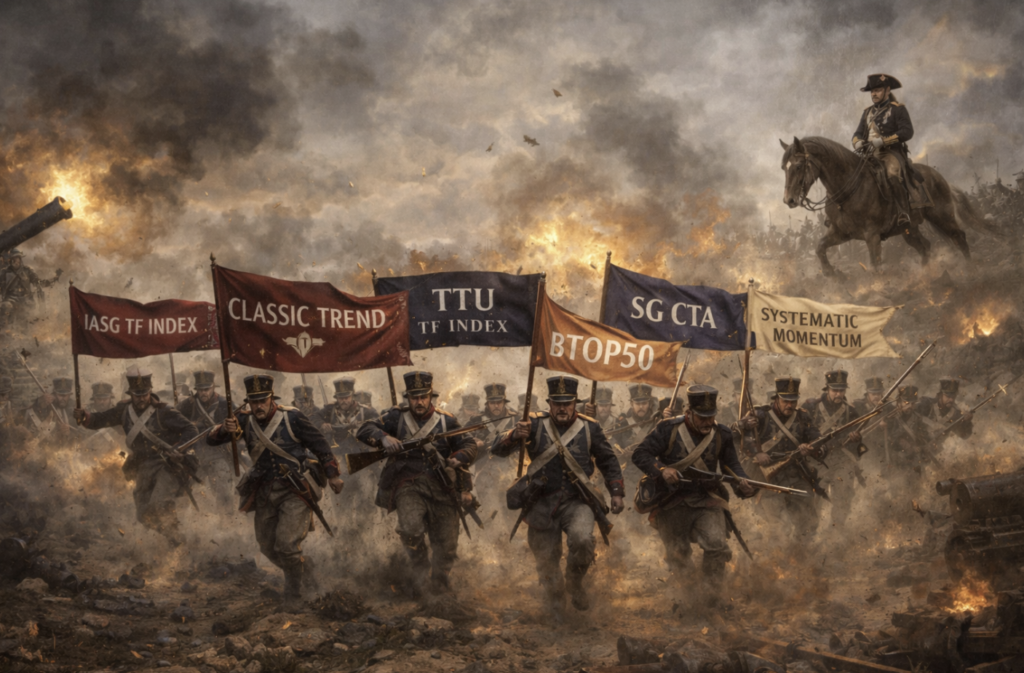
Battle of the Trend Following Indexes: February 2026 The Battle of the Trend Following Indexes provides a monthly snapshot of the leading trend-following benchmarks. All figures reflect performance through 28 February 2026, with index histories rebased to 1,000 on 1 January 2020. February 2026 Result Metals explode, trends surge, and systematic strategies build on an exceptional start to 2026. February extended the strong momentum from January, with the trend-following community delivering another broadly positive month. Classic Trend Index retained its leadership position, advancing 5.3 percent to claim top billing for the second consecutive month. TTU Trend Following Index followed with a strong 4.6 percent gain, while SG Trend Index added 3.9 percent and IASG Trend Following Index rose 4.0 percent. Systematic Momentum CTA Index gained 3.6 percent, Barclay BTOP50 added 3.5 percent, and SG CTA Index posted 3.4 percent. Every benchmark finished in positive territory, marking a second consecutive month of universal gains across all seven indexes. The month unfolded across three distinct phases. An early pullback in energy, driven particularly by the violent reversal in natural gas, weighed on the first week of February, with the SG Trend Index briefly dipping to -0.43 percent month-to-date. The TTU Barometer retreated from 68 percent to 55 percent and then further to 43 percent by mid-month as trend conditions cooled and equity markets wobbled. However, the second half of February staged a decisive recovery. Metals ignited with particular force in the final week: silver surged 12.42 percent, platinum gained 9.08 percent, and gold extended its historic advance above $5,296, reaching fresh all-time highs for the fourth consecutive week. The TTU Barometer surged 16 percentage points in the final week, recovering from 45 percent to 61 percent and crossing back into Very Strong territory as bonds, grains, and energy contributed supplementary gains. Trailing quarterly results reflect the powerful momentum accumulated over the past three months. Classic Trend leads the three-month window at 14.6 percent, followed by TTU TF at 12.6 percent and IASG TF at 11.5 percent. SG Trend added 10.9 percent for the quarter, while SG CTA, Barclay BTOP50, and Systematic Momentum returned 9.6 percent, 8.3 percent, and 9.8 percent respectively. Year to date, Classic Trend continues to pace the field at 10.5 percent after two months. TTU TF follows at 9.9 percent, with SG Trend at 8.8 percent. IASG TF has gained 8.4 percent, while SG CTA stands at 8.3 percent, Systematic Momentum at 7.7 percent, and Barclay BTOP50 at 7.0 percent. Over the long horizon from January 2020, Classic Trend Index’s cumulative advantage has extended further. The index has now gained 152.6 percent since inception, a compound annual growth rate of 16.2 percent. IASG TF follows at 68.0 percent, with SG Trend at 62.1 percent and Barclay BTOP50 at 51.4 percent. TTU TF, SG CTA, and Systematic Momentum sit between 38.5 percent and 48.9 percent. Performance Highlights Here is how the indexes performed in February: Classic Trend Index +5.3 percent for February, retaining the monthly lead for the second consecutive month. Trailing quarter +14.6 percent. YTD +10.5 percent. Since January 2020 the index has gained 152.6 percent with a 16.2 percent CAGR. Classic Trend continues to lead all major risk-adjusted measures with a MAR of 1.03, a Sharpe of 0.98, and a Sortino of 1.80. The metals explosion in the final week of February, combined with strong trending conditions across bonds and grains, allowed the index to deliver its second consecutive month above 5 percent. The cumulative lead over the broader trend universe continues to expand, now exceeding 152 percent since inception. Barclay BTOP50 Index +3.5 percent for February. Trailing quarter +8.3 percent. YTD +7.0 percent. Since 2020 the index has gained 51.4 percent with a 7.0 percent CAGR and the lowest drawdown of the group at 9.7 percent. With the highest proportion of winning months at 63.5 percent, BTOP50 navigated the month’s volatility with characteristic stability, recovering from early weakness to post another positive result. Its defensive profile proved valuable during the mid-month barometer dip when trend conditions deteriorated. SG Trend Index +3.9 percent for February and +10.9 percent for the trailing quarter. YTD +8.8 percent. Since 2020 the index is up 62.1 percent with an 8.1 percent CAGR and a 20.4 percent drawdown. The large-programme trend benchmark weathered the intra-month turbulence and recovered strongly as metals surged in the final week. The year-to-date reading of 8.8 percent after just two months confirms an exceptional start to 2026 for systematic trend followers. SG CTA Index +3.4 percent for the month and +9.6 percent for the trailing quarter. YTD +8.3 percent. Since 2020 the index is up 40.6 percent with a 5.7 percent CAGR and a 16.3 percent drawdown. Broader CTA blends participated meaningfully in February’s recovery, benefiting from the precious metals breakout and bond strength in the latter half of the month. TTU Trend Following Index +4.6 percent for February and +12.6 percent for the trailing quarter. YTD +9.9 percent. Since 2020 the index has gained 48.9 percent with a 6.7 percent CAGR and a 20.8 percent drawdown. The large-ensemble benchmark delivered its strongest monthly contribution since January, reflecting the broad-based nature of February’s late-month trend acceleration. The 4.6 percent gain places TTU TF second among the seven benchmarks for the month. IASG Trend Following Index +4.0 percent in February and +11.5 percent for the trailing quarter. YTD +8.4 percent. Since 2020 the index has gained 68.0 percent with an 8.8 percent CAGR and a 14.9 percent drawdown. IASG continues its impressive balance of growth and consistency, adding meaningfully to January’s gains and maintaining the second-highest cumulative return among the seven benchmarks. Systematic Momentum CTA Index +3.6 percent in February and +9.8 percent for the trailing quarter. YTD +7.7 percent. Since 2020 the index has gained 38.5 percent with a 5.4 percent CAGR and a 16.7 percent drawdown. Momentum strategies participated in the month’s recovery, with the late-February metals explosion providing particularly strong tailwinds for momentum-oriented positioning across precious metals. Performance Snapshot The February VAMI chart shows Classic